Welcome to Silver and Shadow

"Look at that sea, girls--all silver and shadow and vision of things not seen. We couldn't enjoy its loveliness any more if we had millions of dollars and ropes of diamonds." -L.M. Montgomery, Anne of Green Gables

This is a blog I will be using for topics other than food. Politics, religion, spirituality, humor, green living, anything that I want to talk about that doesn't fall under the food/cooking category.


Sunday, October 7, 2018

Burning Walls, Building Bridges: The Supreme Court

In light of the Weepy McDrunkface Kavanaugh confirmation yesterday, I thought I would take a look at the Supreme Court and its role in either upholding or dismantling racism in this country. I am not a lawyer and I have no expertise at all in the subject of the law, so everything I write is just my personal interpretation of the cases. I stayed up until 12:30am today reading through all the different Supreme Court cases from the era of the Civil War, until present day. I focused on cases that pertained to people of color and/or civil rights specifically. There are actually a huge amount of cases from over the centuries, and I read through all of them.

There have been a lot of landmark cases that we know about from over the years, but I think we either forget or just don't know how many cases they weigh in on in the course of a year. Some of them are isolated cases. Some pertain to a particular city or state. But almost all of them can be used as a precedent for future cases. Some lost relevance when another case came along that overrode a previous ruling.

A refresher on how the Supreme Court functions. The Supreme Court is one of the three branches of government. Laws are created in a few different ways in this country. Cities and states can pass their own laws. For laws on the federal level, they are created and passed by Congress, another of the three branches of government. The Supreme Court's function is to interpret laws. Justices are nominated by the President, the third branch of government, and confirmed by the Senate. Justices hear cases not just on a federal level, but on a local and state level as well. Their main aim is to determine whether or not a law is within the confines of the Constitution. Generally-speaking, they don't rule based on the ethics/morals of an issue, which is why there are plenty of examples of them upholding laws that most of us would find reprehensible.

Theoretically, Supreme Court justices are impartial. They interpret the law as it pertains to the Constitution and use only their knowledge and intellect. The problem though, is that Supreme Court justices are humans who interpret the law based on their own life experiences and opinions. They have feelings and those play a part in their decision-making. This is why we see conservative-leaning and liberal-leaning judges and why a balanced group would be considered ideal. When the Court leans one way over the other, the rulings tend to follow whatever the majority is.

My research of the rulings regarding people of color and civil rights showed two distinct patterns. For black, Latinx, Asian, and Arab Americans, the Supreme Court rulings have largely been a case of "two steps forward, one step back." But they have ultimately, pressed forward, towards greater equality for all Americans. It has been a "slow but steady" pace, but it has moved forward, thus far.

Yick Wo v. Hopkins
In this case from 1886, we have a case where institutional racism on a local level(San Francisco), was challenged and successfully dismantled by the Supreme Court. San Francisco had passed a law about the need for people running laundry businesses in wooden buildings to have a license to be in business legally. Then in order to exclude Chinese Americans from running the businesses, the city refused to issue licenses to them, thus allowing the city to shut them down for running illegal businesses. The Supreme Court ruled that it was a violation of the 14th Amendment for such a practice by the city, and San Francisco was forced to stop. This is a great example of something seemingly race-neutral, the need for licenses, being enforced in a racist manner, and adversely affecting one group of people over another.

United States v. Bhagat Singh Thind
In 1923, an Indian man sued the United States in order to become a naturalized citizen. Based on an act from 1906, only white people and people of African decent could qualify to become naturalized citizens of the United States. Thind argued that as a person of Aryan decent, he was in fact, white. The Supreme Court ruled that although he was Aryan, he wasn't Caucasian, and that was what truly determined whiteness in this nation. Therefore, Thind was not white and did not qualify for naturalization.

Smith v. Allwright
This 1944 case deals with voter disenfranchisement in the state of Texas for voters of color. The Democratic party had long ruled the state of Texas and had determined themselves to be a private organization who could make their own rules of who was allowed or not allowed to participate in the primaries. Because of other forms of disenfranchisement, the Democratic primary was the only one available to voters of color. The Supreme Court ruled that this was in fact discrimination based on race and the Democratic party was forced to open the primaries to all voters.

The above are examples of the give and take of fairness and movement forward for most people of color in the United States. For Native Americans, however, with a very few small exceptions, the Supreme Court has been used to further oppress and marginalize them. One could even say that it's been weaponized to inflict maximum harm to them. My personal theory is that in order to continue justifying our presence here and what we did in order to take over this land, laws and their interpretation have always erred on the side of the United States. To give too many rights to Native Americans would have been seen as de-legitimizing our presence here.

Elk v. Wilkins
This case from 1884 declared that Native Americans could not be considered citizens of the United States because they lived on reservations and were therefore loyal only to their tribes. The citizenship of Native Americans would be permanently decided by other means, but it is still technically on the books as the only ruling the Supreme Court has ever made regarding citizenship of Native Americans.

Tee-Hit-Ton Indians v. United States
A 1955 case determined that a subtribe of the Tlingit people of Alaska had no right to financial compensation from the materials taken from their land by white people, because they weren't a tribe of their own.

Menominee Tribe v. United States
In a rare victory in 1968, the Supreme Court ruled in favor of a tribe even though they were no longer legally recognized by the federal government.

Mescalero Apache Tribe v. Jones
This case from 1973 was a bit of a draw. The Court concluded that the federal government had the right to tax forms of business on tribal land, but that they could not tax the actual land itself.

Oliphant v. Suquamish Indian Tribe
In what I could consider an extremely dangerous precedent set in 1978 in this case, the Supreme Court ruled that tribes were not allowed to prosecute non-tribal members on reservations, regardless of whatever crimes they may have committed on the reservation. This has effectively given non-Native people carte blanche to go onto reservations and commit whatever crimes they desire, without facing prosecution. When we hear stories of Native women being murdered or disappearing from their land, we can most likely thank this ruling for why it happened and why, if a person is ever caught, very little is bound to be done about it.

Though the Supreme Court hasn't made as many civil-rights-related rulings in the last couple of decades compared to the 1950's and 60's, there are still some being made. There will most likely always be race-based cases to be heard, sadly. Just last year, the Supreme Court upheld Trump's ban on several predominantly Muslim nations. While Muslims are not a race of people, the fact that all of the nations on the list are largely non-white nations, I am including it as an example. The Supreme Court voted along their liberal/conservative leanings to uphold the majority of Trump's ban.

With the retirement of one liberal justice and the confirmation of a conservative justice in his place, the court now leans conservative. This doesn't bode well for people of color hoping to find justice in the highest court in the land. Of course, only time will tell how all of this plays out. From what I read of the cases, so much of it depended not on the actual rightness or wrongness of the case, but in how well the case was presented. People fighting for civil rights will have to make sure to present air-tight cases that leave little to refute.

This brief look at the Supreme Court and some of their rulings over the centuries has made a couple points stand out to me. First: While the president is an important figure in this nation, who we elect to the Senate is just as important, if not even more important, in the long run. Congress is often a balancing act for the POTUS so that the Supreme Court doesn't even have to get involved for most of it. Electing people who will confirm the best candidates to the highest court in the land is vital to our nation. Second: The people making the laws will always make them so they work out in their own favor. This means that it's also extremely important for people of color to be a part of every decision-making process in this nation. From city councils all the way up to the Supreme Court.

I know people talk about destroying this system, and I understand to an extent. But I don't think it's the system that's broken. I think it's the people in the system that need to be switched out for better people. People who use the system the way it was set up, instead of finding ways to cheat it. If the system was actually used the way it was supposed to be used, it would be as revolutionary as burning it to the ground. We have to keep fighting to make that happen.


Sunday, September 23, 2018

Burning Walls, Building Bridges: White Fragility


Today's post is dedicated to this book, which I got from the library and read in less than two weeks,(which is fast for me) and promptly ordered a copy of my own because I found it so helpful in my quest to rid myself of my white privilege and the racism in which I partake. It's a very well-written, easy-to-read book and I recommend it to anybody who is trying to do the same thing. I particularly recommend it to any white person who isn't trying to come to terms with their white privilege and don't want to dismantle institutional racism.

So, what is white fragility? White people are used to being the default. We are used to being what is considered "normal" and everybody else is measured against us. It's why people of color are looked at as "fill in country/continent of origin"-Americans, and white people are just "Americans". We are also used to being looked at as individuals with our own thoughts and ideas, not part of a collective. For example, when a crime happens by an individual from a marginalized group, the media often portrays their entire community as guilty of or inclined to participate in such activities. You will see individuals from that community speak out and condemn the person and distance the rest of the community from that person. When a white person does the exact same crime, the media portrays that person as a "lone wolf" or a "disturbed individual". Rarely do you see other white people speaking out to distance the rest of white people from that individual, because we know that they don't represent the rest of us. We're all individuals, after all. White fragility is the knee-jerk reaction we all have when we hear white people being talked about as white people. It's that moment of indignation we have when we are referred to as a collective, instead of as an individual. If you have ever responded with something along the lines of "Not all white people," "I don't see color," or "But we all experience racism," then you have responded with white fragility. It is the part inside all white people that demands to be looked at as not racist and as an individual, outside a collective. The truth is, however, that we are both of these. We are racists and we are a part of a collective. Becoming more comfortable with these uncomfortable truths is the key to dismantling our white fragility which will put us farther along on the path to dismantling the racism in ourselves and in our institutions.

The author, Robin DiAngelo has a lot of good points in her book and I took notes on some of them that I will share here. 

The first point is that the concept of disabling racism begins with ourselves. It is by nature a solitary and self-centered endeavor. This might feel selfish at first, but it's important for two reasons. One-It keeps us from falling into the self-righteous trap of pointing out how much worse other racist white people are, so we, by default, seem less bad. This just reinforces our white fragility. We must stop pointing out how much worse other white people are, because it only continues to make us feel like individuals instead of part of the larger collective of white people. Two-This also keeps us from becoming white saviors. We do not need to "save" people of color. We just need to get ourselves right and then turn the fight outward and upward to dismantle or revamp institutions that reinforce our racist system. When the systems and our attitudes are adjusted properly, things will fall into place for everybody. It's a simple concept, but far more difficult to do than we'd ever care to admit.

Another point I gleaned from the book is this: addressing our white fragility and working to move past it, is not about being looked at as amazing or "woke". It isn't about being seen as one of the good people or better than other white people. It's about doing the right thing, because it's the right thing to do. If we hope for or expect accolades or respect, then we're in it for the wrong reason. 

The book talks about a "good/bad binary" which I found really helpful in explaining racism in white people. We tend to look at racists as "bad" and if we know ourselves to be "good" people, then logically, we cannot be racist. But that's not how it works. Racism is deeper than our goodness or badness. It's our default. It's the default of the world we have created. We can still be good people who are racist. It's up to all of us to decide how we deal with this.

Another concept the book talks about is how we are willing to accept criticism. I haven't personally experienced this because nobody has called me on my racism, but I imagine I would be able to check off the entire list the author gives of just how and where and when white people will accept criticism from people of color about our racism. I'm sure I could totally handle it, as long as the person doing it is nice to me, and apologetic while doing so. As long as they don't yell at me or act angry towards me, I'm sure I'd be fine. Because of course, I didn't mean anything by it, and of course I'd never say something hurtful on purpose. Shouldn't they know that about me? As long as it's done on my terms, I'm sure I would be totally fine with being called out on my racism. I might not even cry or react with my white fragility as a default. If that sounds like you too, you definitely want to read this book.

One of the most important things this book did, was make me look at my life now and in the past, to see where I am racist. How do I benefit from living in a racist system, and what exactly am I willing to do to dismantle said system when it works so well for me? Because admitting we have a problem is the first step to recovering from it, I am going to willingly place myself in a vulnerable place. I am going to go first, and tell the world, how I am a racist who benefits from living in a racist system.

I live in Seattle. While we have the reputation of being a very liberal city, on closer look, it is a highly segregated city. I grew up and still live in the northern part of the city, which is largely white. The vast majority of my teachers and fellow students, were white. Everybody in my neighborhood and all of my friends growing up, were white. I didn't dislike people of color, it's just that there weren't any in the places I inhabited. We didn't visit places where people of color lived, because they were both too far away and too "dangerous" as neighborhoods. Everybody knew that South Seattle, the Central District, and the International District, were unsafe places to live or visit. The news told us so all the time, and what motive did they have to lie to us? My family never had any reason to go to those places, so we didn't. But it wasn't because of hate. It was just one of those things.

Because I grew up in a largely white world, race didn't exist for us. It was never a problem for us. We knew it was a problem "out there" for other people, but it wasn't our fault and it wasn't our issue. Sure it was unfair, but what are you going to do? It's really sad that the world is so cruel and unfair, but it's just the way it was. 

Growing up in the 80's and 90's, most of the things I watched on tv or in movies, were filled with white people who looked like me. Except the commercials, which were filled with images of starving naked African children, dying for goodness knows what reason. We learned very early on that Africa was filled with starving people that we Americans needed to take care of, because they were clearly unable to take care of themselves. Everybody knew that it was totally corrupt "over there" and that the governments just looked out for themselves. Not like here, of course. There was no history lesson attached to these commercials explaining just how this had come to be. Colonialism...that was back when the Revolutionary War was, right? But we hoped for the best for those poor people from Africa. We even wrote a Christmas song about it and how there would be no snow in Africa this Christmas. We sung about how we were the world, and the people, and all the money earned probably went somewhere to help somebody, and we felt so good about caring about others. We were really proud of ourselves.

There were shows on tv that I did enjoy growing up. Fresh Prince of Bel-Air, A Different World, The Cosby Show, and Living Single all stood out to me as great examples of tv shows focusing on a group other than myself. There were no shows about Asian Americans, Native Americans, or Latinx Americans, but I did enjoy those shows. But they were always looked at as standing out from the mix of shows I watched as a kid. They were "black" shows and I knew full well that they were. They were outside my experience, but I still enjoyed them. For white people to enjoy these shows, it showed how not racist we were. Even as young people, we knew it was better to be viewed as not racist. But this isn't the same thing as being not racist. 

And they were hardly an equal amount of shows compared to shows geared towards a white audience. According to Wikipedia, there were approximately 1900 tv series from the 80's and 90's. Out of a 20 year time span, I listed 4 tv series as the ones I watched, and in my mind, must have summed up what it meant to be a person of color then. 4/1900 can hardly be considered a comprehensive example. There were other shows of course, but I didn't watch them as much.

As I grew up and went to college and entered the workforce, I never had to wonder if my skin color would be a barrier to me. Because I knew it wouldn't. My schools and workplaces were mostly white, and when I worked in the restaurant industry, most of the people of color were the bussers or dishwashers, who spoke little-to-no English. Or they grew and picked our food or cleaned our hotel rooms. And since everybody knew they may or may not have been in this country legally, these were the only types of positions available to them in the workforce food chain. But what could you do about it, really? It's just the way it was.  

As an adult, I still don't go to certain neighborhoods because they are too far away or too "unsafe". Or because I don't know anybody there or am afraid I'll be unwelcome. So, I stay in my "safe" white neighborhood, were I interact with mostly white people, work at jobs with mostly white coworkers and clients. I stay in my white bubble, privilege well intact. I don't tend to challenge it or question it or try to change it, because what's to fix? I'm a good person and I don't have hate in my heart because I was taught to love all people. I live a relatively easy life, in which my whiteness is never named and is never a problem. I know that other people experience racism, but I never actually witness it. They live in parts of Seattle I don't go to, because they're too far away and unsafe. And when I am around people of color, I make extra sure to monitor whatever I say or do, in order to not offend anybody or upset anybody. I smile, I'm very polite, nice, and helpful, just so they'll know for sure that I harbor no hatred in my heart towards them. I don't want to be accused of being a racist, after all. Because that's simply not the case.

I fight for things I feel are the right thing to do, but always it comes from a place of privileged perspective. I never consider that people might have different needs or different ways to resolve issues. It just never occurred to me, because everybody else around me, is just like me. (Note: white people can use being part of a collective to our advantage, whenever it works in our favor to. Otherwise, we do ask that you look at us only as individuals. We like to work the system both ways whenever it would work out in our best interest to.)

Sometimes I still find myself thinking that if we all just got along and loved each other, there would be no more racism and everything would be just fine. What a perfect world that would be. One day, we might get there, but until then I'll just keep waiting and hoping for the best. Because, what else can I do? The system is too big and I'm just one person. What's the point of even trying?

And that is how I am a racist. How are you a racist?


Sunday, September 9, 2018

Burning Walls, Building Bridges: Colin Kaepernick

Burning Walls, Building Bridges: My journey to learning about what institutional racism is, and how to help dismantle it.

Welcome to the first of a new series on combating institutional racism in the United States! I hope this will be a good chance for all of us who are hoping to help make a change in this country, to figure out the best way to go about it. Since this is the intro post, I will explain what I think is the most helpful way to engage in this issue, and also tell you a little bit about myself. My hope is that this will spark a dialog about the issues that we can all come away from a little more enlightened about.

The "Rules": Obviously any and all people are welcome to read and participate in this, but I am assuming that most people reading this will be white. As a white person living in this country, I can see how segregated we still are in our lives and acknowledge that most of the people in my life, who will have access to this blog, are also white. Because of this, we all come from a place of privilege but may be in different places of realizing and acknowledging it. My hope is to create a safe place for people to ask questions or comment on things without having to worry about being judged for it. One of the things white people who are further along on their journey of dismantling racism in their lives tend to do is rely on self righteousness to make sure they feel better about themselves. "I'm woke, so I'm good, but look at what that white person just said! Let's destroy him so that I can keep showing others just how woke I am." It becomes the "I'm the most non racist person" contest and it doesn't resolve anything. If anything, it makes the problem worse and it plays into our own insecurities. We stop growing when all we do is accuse others of being worse than we are. So, that stops here! No more of that! Unless you make a comment that is blatantly and unapologetically racist, I will do my best to never attack you or respond in anger and I ask anybody else following this blog and commenting, to do the same.

The Format: I will try to do a post every other weekend or so, depending on where I am in reading books and articles on this subject. I would like this project to be sustained over time and I have to tendency to do too much too soon and get burned out. 

About Me: I am a liberal woman from Seattle. I'm 40 years old. I don't post where I work online so I won't be sharing that information here, but it is a place that works for the public in a non-profit setting. I identify as "whitish". What in the world is that, you are probably asking me right now. I am white, that is how I look, that is how society sees me. I have been granted full white privilege. However, I actually have a small (2.5%) amount of African DNA in the two DNA tests I have taken. This confirmed what I had suspected based on my research over the past several years. While I acknowledge that I have no place in today's black communities in this country, and I would never try to worm my way into them(see Rachel Dolezal for an example), I know that I have black ancestry in my history. I have chosen, unlike other white people who choose to ignore it, to embrace it. I do not share a present with today's black communities, but I do share part of a past. And because of that, things like white privilege stand out a lot to me. The arbitrary nature of how it's assigned, I feel that very sharply. How can I not? And certain issues hit me on a more personal level now than they did before, even if they still don't actually affect me or my life. So, I decided that instead of ignoring my history, I could embrace it and use my white privilege to reach out to other white people in hopes of helping us as a community to move forward in how we handle racism.

And now, a definition: Racism. We prickle at this word when it comes up in conversation or is used in relation to us. We don't hate anybody! We don't even see color! We're colorblind. We don't actively try to keep anybody else down, so how can I be racist? Not all white people are racist!-Which translates to, other white people might be racist, but I'm not, so make sure to acknowledge that when you talk about racism in this country. I am exempt. The problem is, racism doesn't mean what we think it means. Even though the dictionary defines racism as more of the hatred and active oppression of people, the meaning has changed to now mean a person who benefits from living within a system meant to benefit one group of people over another group of people. What we think of as racism would really fall under the category of prejudice.

Here's a good article about the definition of racism. And I would highly encourage you to read the comments on this article to see the kinds of things people of color have to deal with in order to point out racism to white people. White people can be incredibly angry and defensive when they are told that they benefit from a racist system. It isn't the job of people of color to teach white people about their racism, and most of those who do take the time to point it out, get attacked. This is one way we can take on fighting all levels of racism, by taking on those hostile white people ourselves.

This Week's Topic: Colin Kaepernick's Thwarted Message
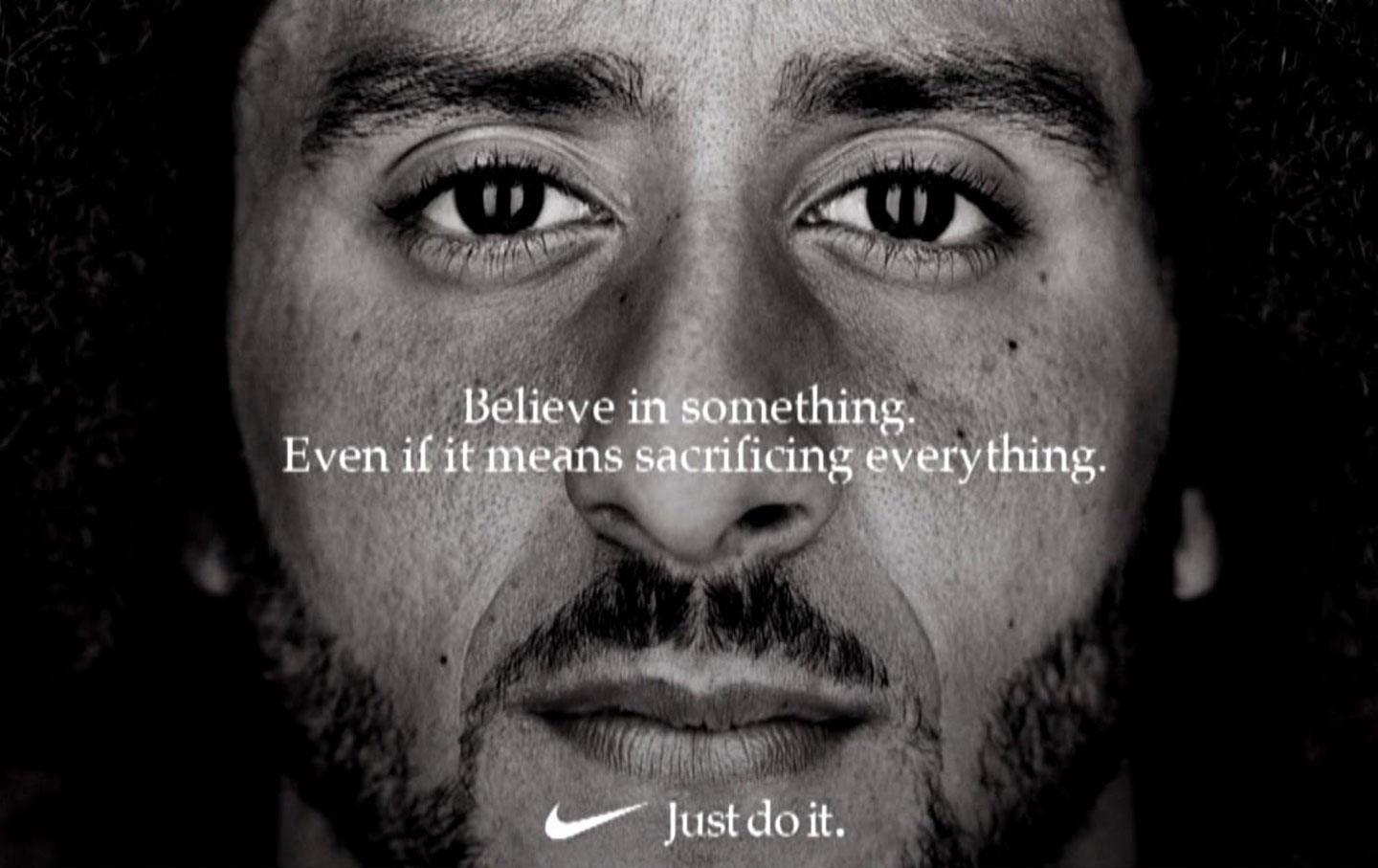
Because I'm just starting out and I haven't read any books yet, my topic is something that has been in the hearts and minds of a lot of Americans since it started in 2016 and had resurfaced when Kaepernick teamed up with Nike for an ad campaign that began last week.
(Source)

Here is a timeline of Kaepernick's first year of protesting police brutality and racial inequity in this nation's justice system, and people's reactions to it. When it first started, nobody really knew what to make of it, but when he started gaining national attention, people began finding reasons to disagree with it. The one that stuck, though, was the idea that sitting during the anthem, or even taking a knee, was somehow disrespectful to the military. Conservatives and conservative news sources latched onto this idea and used it to change the conversation from police brutality and inequity in the justice system, to one of who has the right to protest and under what conditions protesting was considered acceptable. As liberals and liberal news sources fought back, they further continued the discussion of protesting and how it should be done. The message Kaepernick was trying to promote, was buried and the status quo of inequity has continued unchallenged. The conservatives won this battle, with help from us. White privilege is still very much intact and we can go about our day not worrying about what happens if we get pulled over by the cops or have to go to court for something. Too bad for the people who do have to worry about those things, but we had to stand up for the right to protest, right?

I am not going to debate the merits of Colin Kaepernick and whether or not he is "good enough" of a person or a citizen to be the conveyor of this message. I tend to look at all those arguments as continuing to take away from the discussion of racial inequity in the justice system(notice I'm using that phrase a lot? That's because I'm trying to put the focus back on the message, not the debate on protesting. This is a simple tactic we can use to help move the argument back to where it needs to be.) This issue is something very important to Kaepernick and he has the ability to use his current position to bring awareness to something very wrong in this country, and he is doing it. And since nobody else is really standing up for it, he's the man. He's the one, and he is not standing down. The moment we bog ourselves down in "But he doesn't do this or he did do that, and that makes him not a good enough person to convey this message," we are ending the message. We are saying that we will only support this issue if the person talking about it fits our narrative. We're saying that we're waiting for a more ideal or "model" minority to convey this message and until that happens, we won't have anything to do with whatever the message is. This is what is known as "gatekeeping". It makes the white people who do believe in the message, but don't want to align themselves with the messenger, upholders of the racist status quo. This undoes everything we claim to stand for and only works to make us feel more superior than others.

Here's one thing to keep in mind about him, if you are having issues accepting him as the face and voice of this movement: Do you think he's really happy that he has to be taking this stand at all? Do you think it excites him that his football career has been decimated and that he himself is in danger any time he is pulled over by the cops? That he has to see his own community torn apart by the inequity in this country? I highly doubt it. He probably hates this just as much as the people who hate him for standing up to it. 

So, going forward, if you believe in Colin Kaepernick's message of racial inequity in terms of the police and the justice system in this country, the easiest thing you can do when you hear others talking about it, or see them online, is change the conversation back to that message. When we hear the debate going on about protesting and taking a knee during the anthem and being respectful towards the military, take it back to the original message. Don't fall for those red herrings. We're only upholding a racist system by doing do.

Does anybody have any thoughts or questions about this? If you have suggestions on books or articles I should read about institutional racism, please share them with me. And if you have any thoughts on a particular institution or industry that we should explore in depth to see how racism affects it, please let me know those too. I have a list going but I'm sure it's hardly comprehensive. I am currently reading a book that I hope to finish and talk about in the next post. So, until then, keep fighting the fight for equity!
-Summer

Saturday, March 24, 2018

Enough is Enough

"Compromise where you can. Where you can't, don't. Even if everyone is telling you that something wrong is something right. Even if the whole world is telling you to move, it is your duty to plant yourself like a tree, look them in the eye, and say 'No, you move'."--Sharon Carter, Captain America: Civil War

When I was a fifteen year old sophomore at Ballard High School, there was a shooting. It was a nice, warm spring afternoon, blue sky, and the classrooms had their windows open. I believe I was in my English class. We heard the gunshots coming from outside but couldn't tell where exactly they had come from. *Pop pop pop pop pop* We all stopped and looked around, confused, trying to figure out what had happened. None of us had ever heard gunshots before, except in the movies or on tv, but we knew it had been a gun. One of our classmates had left a short time earlier to use the restroom and it became an obsession for us that she return as quickly as possible. When she came back, we breathed a sigh of relief because we were all accounted for. The door remained shut and we all stayed where we were. This was before the time of lockdowns, so every teacher just had to fend for themselves.

At the end of the day, we were allowed to go, but one part of the outside area of the school was cordoned off by the police, and school buses were being rerouted away from it. It turned out that there had been a drive-by shooting and one of the girls outside the school had been shot and killed. 

The girl had been in my history class. It was surreal to have seen her that day in class, but then to not have her there the next day. Or the day after that. Or the day after that. There were no grief counselors, because there was no protocol for this. We just did our best to get through it. For me, it set off a severe depression that lasted about a year. I lost weight. I couldn't sleep. I didn't know what was going on, except thinking I was losing my mind. I hadn't been hurt. I was safe. I got through it. Except of course, I hadn't. And I wasn't safe. And I might not have been physically hurt, but I had been emotionally and mentally hurt. 

Young people aren't supposed to die. We're supposed to be immortal. We don't get shot and die. Except that they do. My classmate did. She was there one day, and dead by the end of the day. And then she wasn't there the next day. Or the next. Or the next. 

While I never experienced a school shooting inside the school walls, I have experienced the loss of a classmate to gun violence. I heard the shots that took her life. And while it might have been a person pulling the trigger, it was definitely a gun that killed her. I know a little of the pain that students experience from school shootings. I know what it is to contemplate your mortality at the age of fifteen. I know the existential crisis it throws you into, and the depression, and not knowing what to do about it. I know that feeling that nothing matters because it's all a waste. I am thirty nine years old and I can put myself right back into those feelings. I feel fear and frustration and anger creeping up inside me right now as I type this post. Like any grief or trauma we may experience in life, we never truly get over it. We just learn how to live with it. It becomes a part of who we are. The scars that make up our lives.

This is the lens through which I see every mass shooting. This is why I support gun control measures. This is why I will always hate guns. This is why I am saying that enough is enough. Because nobody should have to experience that pain or depression or trauma. I am tired of a nation that worships metal idols that demand daily human sacrifices. Enough is enough. 

Like the #MeToo movement, a lot of us have a story to tell about gun violence. I think it's time we started telling it to everybody. Most of us have scars due to gun violence, and it's time to stop covering them up and pretending they don't exist. It's time to expose them for all the world to see. I would encourage everybody to tell your story. Tweet it, blog it, put it on tumblr, post it to Facebook. Tell people in person. Anybody and everybody who will listen. Because I don't know about you, but I'm tired of having to relive this pain with every mass shooting. So, I am owning my pain, and utilizing it as my part in this fight. Never again. We're done. Enough is enough.

Sunday, February 11, 2018

What Bothers Me About Black Panther

It’s been in the back of my head this whole time that the hype around Black Panther has been building up. I couldn’t pinpoint what it was, though, until I finished reading Hidden Figures, the novel. There’s a passage in the book talking about the black women who worked for NASA, and how they had to be the very best. The highest example of their community. The smartest, the greatest. The idea being that they had to be the best of the best of the best before they would even be acknowledged as adequate by white society. And it hit me, that even in this day and age, we still treat the black community, and any minority or “other” this way.

Black Panther doesn’t get the luxury of adequacy or mediocrity. It has to be the very best. The best Marvel movie ever made. Because otherwise, it doesn’t “deserve” to be made at all. We, as the white audience, will look at it as the standard set for black-led movies, and every other movie with a predominantly black cast will have to meet and probably exceed those expectations. Because if they don’t, they won’t get made again. Case in point: Look up Proud Mary starring Taraji P. Henson and see how it was marketed, if at all, and how it did in the box office. A flawed movie with a black female lead goes nowhere. But if it had been a Scarlett Johansson movie, it probably would have done just fine. And if it had been a Tom Cruise movie, it probably would have been a hit...

Just like Wonder Woman had to be the most amazing superhero(ine) movie ever made just to be considered on par with every other superhero movie ever made, or we’d never get another one in our lifetime. It’s why Captain Marvel has me worried that it won’t live up to what Wonder Woman was. And it’s sad that those two films are automatically pitted against each other because of that. Captain Marvel has to be even better, or that’ll be the end of women-led superhero(ine) movies. The fact that movies like this have to be in competition with each other to win over the white male audience is disturbing and disappointing.

Movies are still viewed through a white, male lens. Even Black Panther, sadly. It has to smash records and break glass ceilings and then when the numbers come back, studio execs will say, “Huh, maybe there is a market for this...” Maybe one day, minority groups and “others” will be afforded the luxury of mediocrity, but that day won’t come for a long time yet. Until then, we need to continue supporting these movies with as much enthusiasm and money as we can in hopes that some day, there will be so much variety, that when a mediocre film comes out that has a predominantly minority or “other” cast, we don’t blink an eye or wonder what’s going wrong with X-led casts. We’ll just move on to the next movie, like we already do with white-led casts.

Tuesday, November 7, 2017

2017 Election Night


“And so tonight-to you, the great silent majority of my fellow Americans-I ask for your support.”
 -Richard Nixon, November 3, 1969

Maybe Nixon was right about something. I know you must be thinking I’ve lost my mind to say such a thing about that man, but hear me out. Nixon coined the phrase “silent majority,” a phrase used ever since to describe American politics. The idea being that most Americans go about their business, keeping their politics to themselves, except in the voting booth. (This was of course, well before the advent of social media…) They are a fickle people who don't lean one way more than the other. They are the people who make most of the decisions in this country.

Today’s election, and the results that are coming in tonight, show a shift in the tide. How deep a shift and how long it’ll last is anybody’s guess. But could it be that the Silent Majority has had a year to live with the results of last year’s presidential election and has decided to be silent no longer? Have they quietly watched their fellow Americans being threatened for their religion, gender, gender identity, sexual orientation, immigration status, and race, and realized that this cannot go on any longer? Have they seen their cities taken over by Nazis and nationalists with tiki torches and swastikas and decided it had to stop? Have they seen the president act petty every time he opens his mouth? The disrespect he’s shown for soldiers and natural disaster victims don’t seem to be warming their hearts.

Does this mean that the majority of Americans in this country really are good people who are horrified by what is going on in this country right now and that we’re all being held hostage by a small minority of terrorists? I like to think so. Or at least I like to hope so.

I don’t care if you stay silent in your words, Silent Majority, as long as you act and vote as loudly as possible. I would hope that the Silent Majority will show up again next year for midterms. We could definitely use their help…even if they do so quietly.

Saturday, September 2, 2017

Work and Life

So, I am officially unemployed. A saga that began about halfway in April of this year, has come to an premature end. I was originally planning on staying till the end of October, but life had some other plans for me instead.

Back in April, our department was given news about a change to how we would be functioning. Instead of a collection of specialists who each worked on our own specific tasks, we would be cross-training in everybody else's jobs and rotating around in a sort of job-sharing system. I wasn't terribly excited about this idea or interested in learning some of the tasks in my department, but was willing to give it a try. I have always been able to put up with whatever came my way there, because I was at least able to choose which hours I work. I worked a 7:30am-4pm shift, and it got me home by 4:30pm on a really great traffic day. But halfway through April, we were told that another change was being made to the department: new hours. We had our choice of 9am-6pm with an hour lunch or 9:30am-6pm. There was no other option if I wanted to remain in my position at the company. I opted for the 9:30am start time and also very quickly came to the decision that my last sense of control with this job had now been taken from me, and I wasn't going to stay. The question was then, when to leave?

Due to how things were announced, the dynamic of the department, and because the last bomb dropped on the department was that we only had six months to cross train in all of these job tasks, it just sort of happened that I told them from the start that I wasn't going to stay. I would try to stay for the six month training period in order to be an extra body to take over smaller tasks, as well as to help train my team in my job as best as I could before I left. TPTB were ok with this, and even appreciated that I was saying to help train. In theory, it would also have allowed me the chance to job hunt while remaining employed. I managed this a little bit, but found employment a hindrance, in the long run. Because I had a guaranteed thing going, the pressure to move on wasn't there. Also, the time of my shift made it difficult to work on sending out resumes to places.

I did my best to change my life around to fit the new schedule. I stayed up later in hopes of sleeping in later, but it never really worked. I have always had problems with sleep, so I ended up basically being a zombie the whole time. I was now getting home closer to 7pm, making cooking dinner pretty much impossible. I had no energy to clean, so dishes piled up, my apartment is a mess. I had no time to exercise. The only positive during this time was that my creativity exploded. A new book idea came to me that I had to run with and I'm still working on it.

Fast forward to about a month ago when I received a random email from my doctor's office saying that when I'd seen her earlier that year, my blood pressure had been a bit high and they'd like to follow up on it. I contacted them about using one of those blood pressure machines at a grocery store and letting them know the results via email rather than making an appointment just for that. They said that was ok, and I went that weekend to take the test at the grocery store I live next to. Now, I'm no expert on blood pressure, so I didn't know what numbers were the best or the worst. But when I took the test and it was 180something over 110something, I knew that was bad. Like, really bad. And the test said I might want to seek immediate medical attention, which I of course ignored. I did, however, go home and make a doctor's appointment for that Thursday to speak to her about it. I went the next day after work and tried it again and it was actually higher. 190something over 110something. I was getting pretty scared by that point.

My appointment was for Thursday, and the day before I had a talk with myself on the bus going to work. I told myself I was going to pick an actual date to leave and it was going to be before the end of October date. I chose September 1st, a Friday. It was a month out and would give me a bit of time to train people before I left. It would also qualify me for my benefits to extend for the month of September, which was reassuring to me. I lived with that decision for the day and when I went home that night I stopped at the store and took my blood pressure again. It was 50 points lower!

The next day I talked to my doctor about all that was happening with work and how the numbers had dropped so much after deciding when to leave and she agreed that it was in fact the work situation that was creating the issue. I was dealing with work stress and had no outlet for it as well as anticipating the job hunting which I didn't have time to do with this new time, which added to the stress. And it turns out, not getting enough sleep also contributes to blood pressure issues. That day, the blood pressure was down to 140something over 90something. Still a bit high, but significantly less than it had been. She also adjusted my meds a bit. My blood pressure is back in the normal range, which is great, but I hope I didn't do any permanent damage. I have to assume my blood pressure had been elevated for a few months during all of this. I am now the proud owner of my own blood pressure cuff, and am monitoring myself!

I gave my notice to work that next day and we went into scramble mode to train everybody in what I do. It was a stressful month, but one I knew was going to end. It made it easier to deal with. I was worried about how long I might be out of work as I look for a new job. I met with my financial advisor, though, and we discussed my finances. By moving my 401k to a Traditional IRA, I will be able to access funds more easily in an emergency(which will hopefully not happen.) I also have money in my checking and savings to last a few months before things get desperate. Between traditional job-hunting and the Molly Brown Temp Agency, that I will contact in the next couple weeks, hopefully something will present itself to me soon.

Yesterday was my last day at work and there were some festivities which were lovely. At the end of my shift, I handed in my badge and left for the last time. And now it's a three day weekend. I think it won't hit me until Tuesday when I don't go in to work that it will hit me.

My plan is to get my life back under control. I want to clean my apartment, start walking again, and work on my diet. I want to work on my writing and see how much of my book I can get done before I'm employed again. I'll tap into the ACA for medical coverage after this month if I need to(Thanks Obama!) I'm thinking of this as a bit of a sabbatical as I decompress from all of this, and gear up for my next move.

What important life lessons have I learned from this? I learned that the Elsa method (Conceal, don't feel) for dealing with stress doesn't work. I learned that I can do something scary and take a chance when push comes to shove. I'm generally not a big risk-taker in life, but sometimes you have no choice. Both of these things are good to know!

My advice to everybody reading this: Check your blood pressure! You can't feel it, so you don't know what your numbers are unless you test it. If it's high, do something about it! This is not something to mess with!

Well, hopefully my next step will come along very quickly and before I know it, I'll be happily and gainfully employed once again!